Version Workload Reports guide
Eight known hours are not always eight hours of remaining work
A practical explanation of why zero and unknown answer different questions, and why an estimate total needs its coverage beside it.
Published 11 October 2026
A subtotal with a visible gap
Imagine a report that includes three work items:
| Work item | Remaining estimate |
|---|---|
| A | 3 hours |
| B | 5 hours |
| C | Not estimated |
The known estimates add up to eight hours. But the report does not establish that all three items need only eight hours of work: item C has no remaining estimate.
A more useful description is eight known hours, with remaining-estimate coverage of two out of three included items. That keeps the subtotal and the missing information visible at the same time.
Zero and unknown answer different questions
A recorded zero is a known estimate. A missing estimate gives us no value to add for that item. Replacing the missing value with zero would make the total look more complete without adding any information.
Nor does an estimate of zero, by itself, establish that a work item is finished. Work status and an estimate are different pieces of information.
Before using this subtotal to make a delivery commitment, the next step is to understand the unestimated work. Even complete estimates would not, on their own, establish a delivery date: dependencies, availability and sequencing still matter.
How VWR presents this distinction
VWR keeps missing estimates as Unknown, rather than silently converting them to zero. Coverage is shown for each metric, so original estimate, time spent, remaining estimate and variance may cover different sets of included items.
Its three reports—Version workload, Assignee workload, and Estimate & variance—let readers inspect the work items behind their results. Reports use the signed-in user's Jira access; they do not claim to include work that user cannot see.
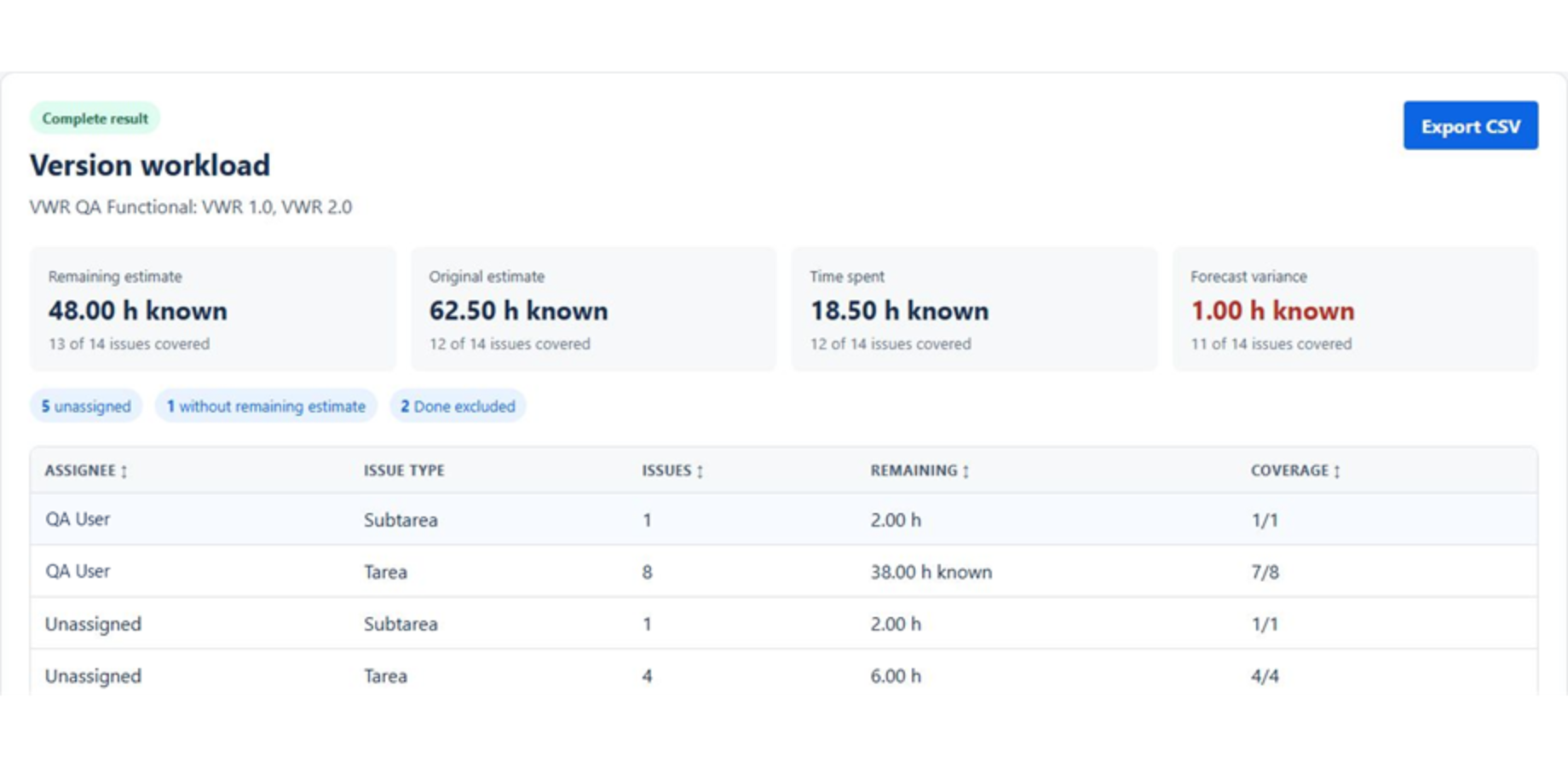
An incomplete retrieval is a separate problem from missing estimates in successfully retrieved items. If retrieval is incomplete, VWR treats totals as non-authoritative and disables CSV export. A complete report can be exported from the displayed result without another Jira query. V1 supports up to 1,000 included work items per report.
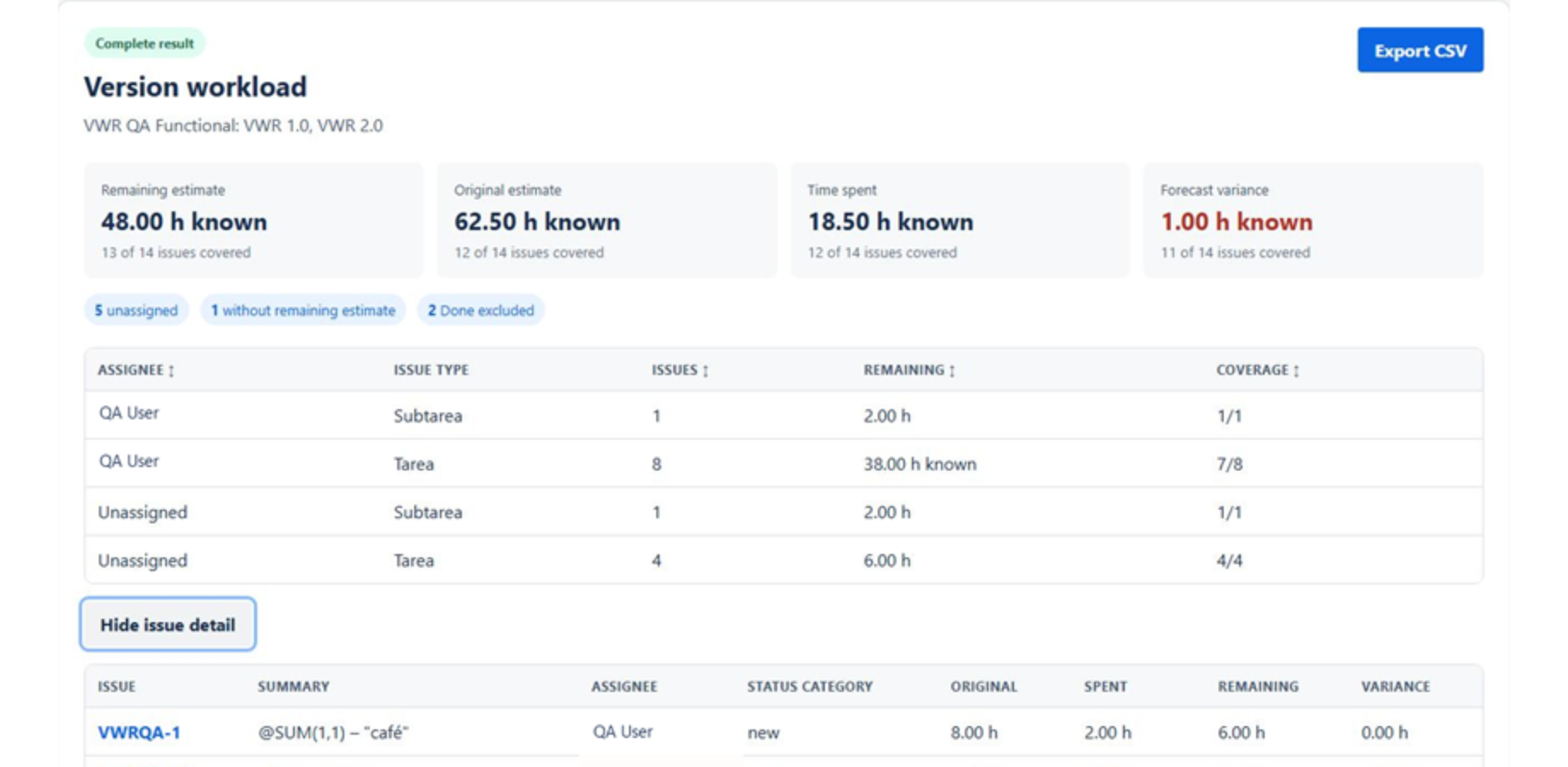
The useful question is not only “what is the total?”
It is also “what does the total include, and what is still unknown?”
Keeping that distinction visible helps a reader decide what needs checking before relying on the number. It does not supply the missing estimate or turn a report into a delivery promise.
Product resources
Read the VWR documentation for calculations, CSV behavior and V1 limits, or review the VWR Privacy Policy for the information accessed and the initiating-user permission model.